-
Dying To Die For
Season 1, Episode 4 Show Notes:
This week we delve into the deadly Victorian era and Laura tells us about how, if you bought anything green, there’s a good chance it was out to kill you.
Before the end of the 18th century, there was no color fast green, only the option to do a blue overlay with yellow or vice versa. Invented in 1775 by Carl Wilhelm Scheele who, ironically is also credited with discovering oxygen, the artificial colorant was made through a process of heating sodium carbonate, adding arsenious oxide, stirring until the mixture was dissolved, and then adding a copper sulfate to the final solution. A year before the color went into production, he wrote to a friend that he thought users might want to know about its poisonous nature. By mixing arsenic and copper, Scheele developed a pigment that would hold almost no matter what the medium. It also happened to look fantastic under natural and new gas light, an important duality for the time.
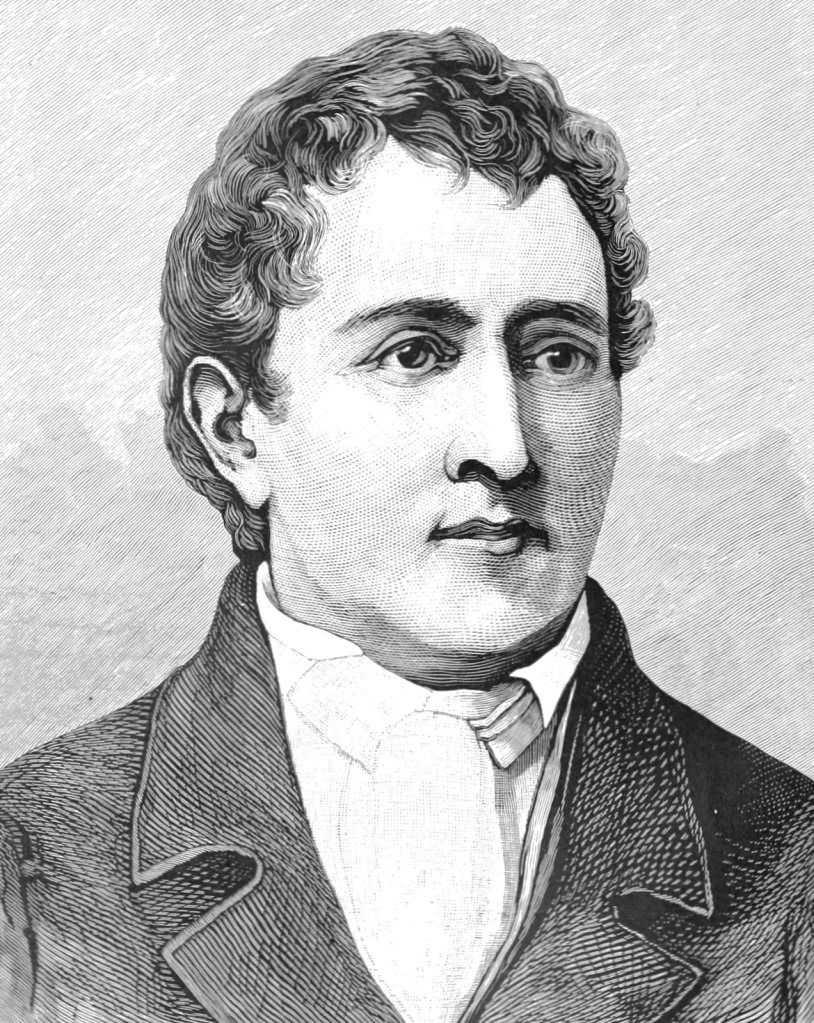
Carl Wilhelm Scheele, c. 1780 via The Popular Science Monthly, vol. 31 (D. Appleton and Company, New York, 1887) Check out the podcast audio to learn a little about arsenic during and after the Industrial Revolution and how this cheap, readily available, poison lead to many unintentional (and intentional) deaths.
As people realized that Scheele’s green was not only cheap but colorfast and able to be applied to a variety of mediums it grew increasingly popular. It made its way onto human bodies in the form of dresses, waistcoats, shoes, gloves, and trousers. It also was found in artificial flowers that were hugely popular for decorating hats, and also, terribly, as a food colorant. Listen to the podcast to learn some of the more tragic stories of people who suffered because of Scheele’s green and the other green dyes that contained arsenic.
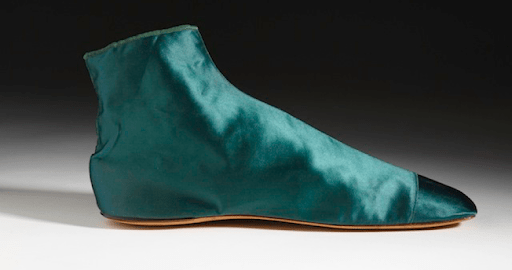
“Adelaide” satin boots colored with an arsenic-based dye, European (c.1840s) (Collection of the Bata Shoe Museum, photograph by Ron Wood) 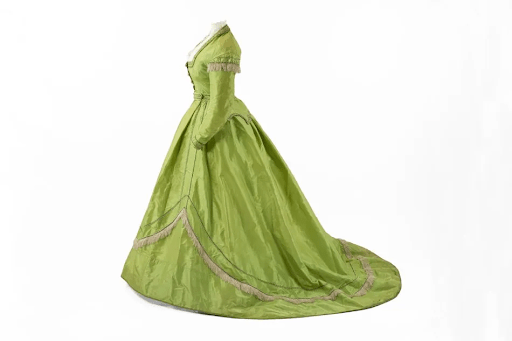
This 1865-1868 gown from Toronto Metropolitan University Fashion Research Collection apparently has tested positive for arsenic. Typically, those who wore green, or worked with it in their daily jobs, but were otherwise healthy were cursed only with a rash or some irritation, maybe the occasional oozing sore. However, many of the arsenic green items that have been tested, along with anecdotes and news stories, show us that many people died from exposure to the green dye during this period.
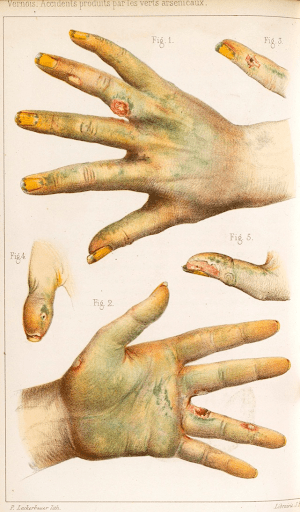
Hands damaged by arsenic dyes, lithography from an 1859 medical journal (via Wellcome Library) Green wallpaper was also incredibly popular at the time, especially from William Morris (one of the major figures of the British Arts and Crafts Movement) who loved greens made from arsenic-based dyes. He was highly skeptical of the poisonous nature of arsenic even while he embraced using organic dyes. Unsurprisingly, this was because there was no organic option available to achieve the brilliant, colorfast green he wanted. This effectively rendered the wallpaper people had throughout their homes toxic, particularly in damp environments where the mold caused it to be aerosolized. Here is an example of one of his poisonous and popular – and Caitlin’s all-time favorite wallpaper – patterns:
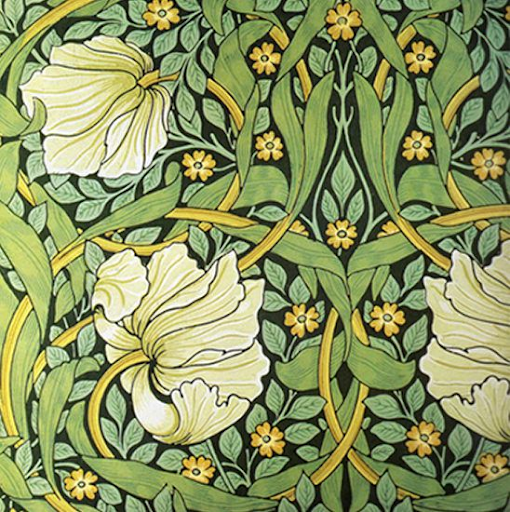
Morris’s Pimpernel wallpaper design, registered 1876 One of the most prominent controversies that involves Scheele’s green, or more broadly arsenic and arsenic green is Napoleons cause of death. While we explore it more in-depth in the podcast, there are a variety of theories – some debunked – including cancer, murder by his British captors, and long-term arsenic poisoning. Although there seems to be no way to definitively prove that long-term arsenic exposure was his main cause of death, especially with a family history of stomach cancer and a stomach ulcer observed in his postmortem, with testing of his hair and (probable) wallpaper it seems fair to say that his exposure to arsenic almost certainly negatively impacted his health and hastened his demise.
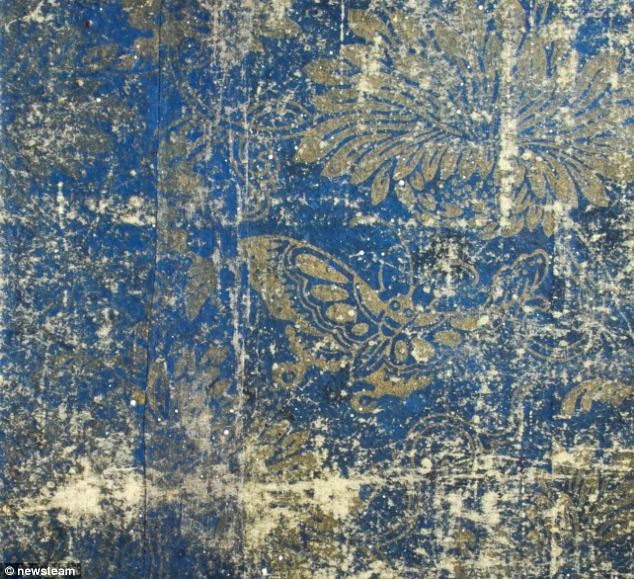
An image of the wallpaper that is claimed to be from Napoleon’s St. Helena home Now that you’ve listened to the podcast and/or read this post…
Check out the picture of Caitlin’s recent antique settee/loveseat purchase below. We need you to vote (below the pic) if you think we should get it tested for arsenic before getting back to restoration. And, on the off chance someone wants to, shoot us an email if you’d like to sponsor this testing.

-
Ennigaldi’s Museum
Season 1; Episode 3 Show Notes:
Detailed show notes coming soon, we promise!
-
Your Favorite Cocktail’s Hidden Past
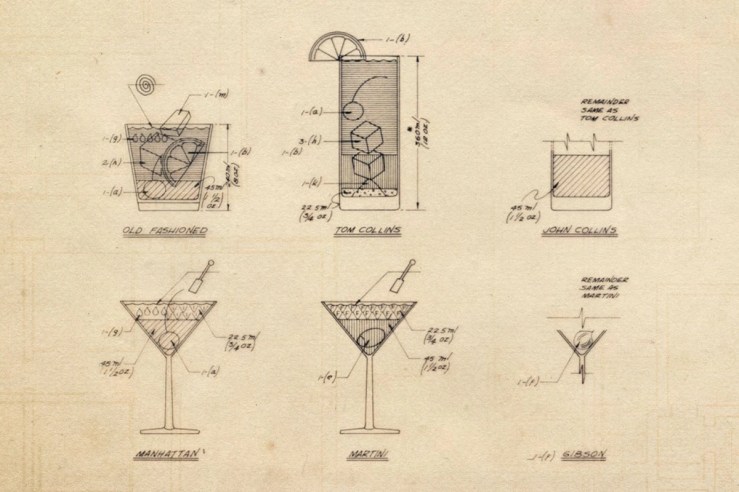
Season 1, Episode 2 Show Notes:
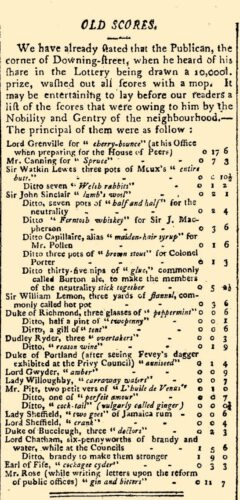
Unlike most people think, the term “cocktail,” as far as we can tell from printed evidence, didn’t originate in America. The cocktail first appears satirically in print in 1798 in a London newspaper called The Morning Post and Gazetteer. The backstory goes that the week before an article had been published that the owner of the Axe and Gate tavern on the corner of Downing and Whitehall that politicians frequented won a share of the lottery and joyfully used a mop to erase his regulars tabs. The satirical article published the next week was a tongue-in-cheek follow-up with a list of politicians (who may or may not have actually frequented this pub) and the monies they “owed” for the drinks they drank, including Tory politician William Pitt (the younger) who would go on to be Prime Minister. Apparently William Pitt, seen at the bottom of this article, owed for “L’huile de Venus”, “perfait [sic] amour” and a less French drink: “cock-tail” (vulgarly called ginger).”
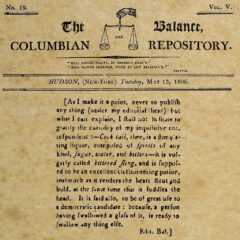
However, we don’t see a definition of what a cocktail is (or was) until The Balance, Columbian Repository, 13. May 1806. It was defined as “A stimulating liquor composed of any kind of sugar, water, and bitters” which does resemble what we know of as a cocktail today.
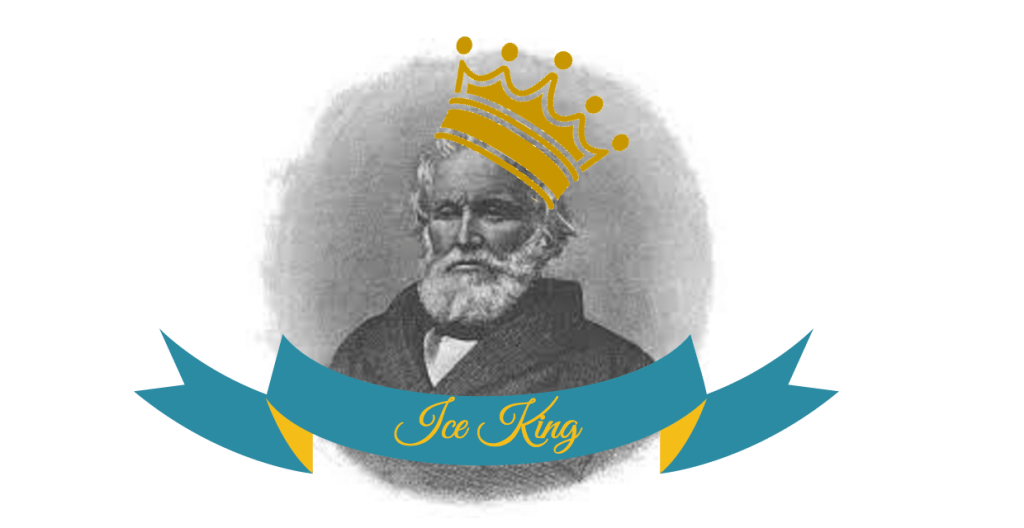
Cocktails had officially made their way to America and there was one man that saw his opportunity to make – well expand, since his family was already rich – his fortune, Frederick Tudor. He liked his drinks cold and saw no reason why he couldn’t bring that luxury to everyone, including those in the tropics. He is credited with saying “A man who has drank his drinks cold at the same expense for one week can never be presented with them warm again,” To be honest, he is probably a large part why we in America are so reliant on ice in our drinks, especially in our cocktails. He was so successful he earned the name the “Ice King” and you can find out a bit more about him here and here (including the source for this fantastic image below).
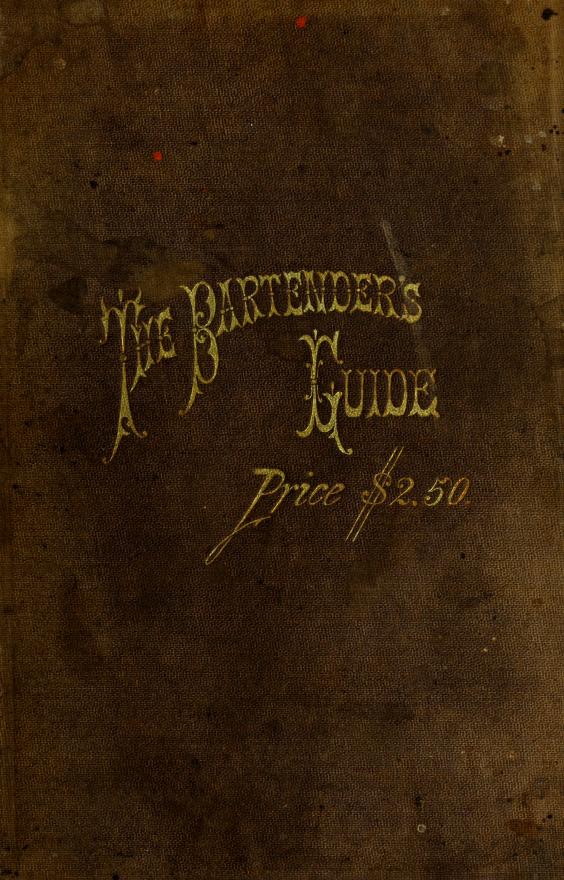
With the rise of cocktails we see the first Bartender’s Guide in 1862 written and compiled by Jerry Thomas. You can find a digitized copy of it here. It not only included 10 cocktails, that were still following the narrow definition we saw above, but many other mixed drinks and guides on proper bar tending practices.
For years Jerry Thomas was blatantly plagiarized and narrow definition of a cocktail prevailed for many. However, there were bartenders across the US and abroad who were expanding how to make cocktails, we can see this in the advertisement for hotel services in the Daily Picayune on February 1st, 1843. This is actually the first reference for using absinthe in what is now commonly called a Sazerac.
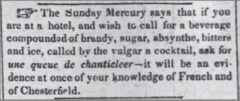
It was long believed that the Sazerac was the first modern cocktail. This is now disputed, especially given that (1) there are references in print before any form of a Sazerac is known to have existed and (2) Sazerac was initially referencing a brand of cognac called Sazerac-de-Forge et Fils and then later was a cocktail bottling company. Listen to the podcast to learn more, but ultimately what we know as a Sazerac today is based off of the Sazerac bottling company’s most successful bottled cocktail (yes, they were popular in the late 19th/early 20th century just like today). Below are some advertisements for bottled Sazerac cocktails.
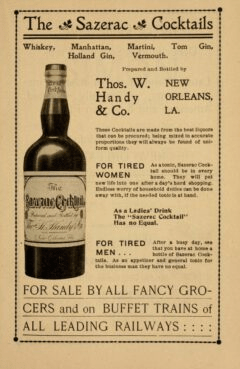
New Orleans Guide, 1902 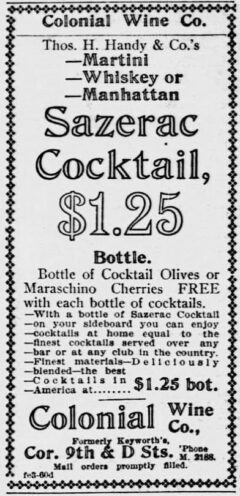
Evening Star, 3. February 1903, page 9 Up until WWI the definition of what constituted a cocktail continued to expand in both bartenders guides and common lexicon. However, after WWI we really see it explode and start to appear in books and advertisements as we see it today, a common term for most drinks that contain spirits. We would be remiss if we didn’t talk about the woman who has laid the foundation for most of the cocktails we know and love today, and that is Ada Coleman, or “Coley”. Listen to the podcast to find out more about her professional life, and then if you would like to know more this website or Wikipedia is a good place to start. She not only invented the “Hanky Panky” cocktail but also was responsible for training Henry Craddock who was a renowned bartender and created the Savoy Cocktail book that is a staple for many bartenders today. It is also worth noting that during Prohibition bartending was a common job in America. Many of Americas bartenders went overseas and traveled, bringing back their knowledge, expertise, and a whole range of new mixed drinks with them when Prohibition ended. While the foundation was laid, this is when the modern cocktail, with its broad definition, became commonplace the world over.
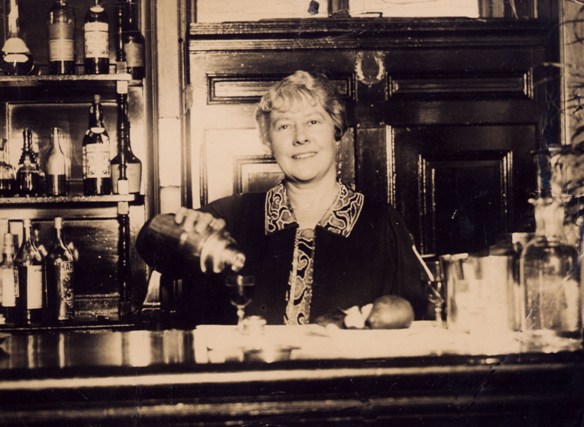
Cheers to our second episode! We hope you enjoyed a cocktail or mocktail while experiencing the podcast and these show notes! Join us in two weeks to find out about the very first museum ever discovered and it, and the relics found there, are probably older than you think!
-
Silent Aid: Support For Nazi War Criminals

Season 1, Episode 1 Show Notes:
Silent Aid for Prisoners of War and Internees Association, or Die Stille Hilfe für Kriegsgefangene und Internierte also called Stille Hilfe, or Silent Aid in English is an aid organization established in Germany following WWII to aid Nazi veterans.
It was officially registered under the name Silent Aid on November 15th 1951 following their first meeting in October of that same year. However, many of the founding members had been active since the end of the war with helping Nazis get out of Germany to the relative safety of South America.
For some basic information on Silent Aid, the Wikipedia page is a decent place to start.
It is known to have aided some of the Third Reich’s most prominent officers, including Gestapo chief Klaus Barbie, The Butcher Of Lyon; Martin Sommer, The Hangman From Buchenwald; and Artur Axmann, head of the infamous Hitler Youth.
There has been a lot of controversy over how involved the Catholic Church and the Vatican were both during and after the war, and if they were involved, what the motivation was. The US has fallen under the same scrutiny, especially in regards to how much the government knew or participated post-war, in protecting post-war Nazis. This is particularly true when it came to high ranking scientists that the US wanted for their own programs like Wernher von Braun who ended up becoming the Director of NASA .
However, we almost never hear of the group that was operating within and immediately around Germany that was extremely well-funded both by royalty and Nazis who had amassed wealth under the regime – often, or always, illegally.
Ok so we are going to talk about the founding members, buckle up because it is surprising.
Once it was officially established the president of this group was named as Helene Elizabeth (sometimes spelled with an “s”), Princess von Isenburg. She was wealthy, married to an anti-semite and very well connected in both aristocratic and catholic circles. There is not a lot of information available about her in English online. If you are interested in learning more here are some great places to start:
Helene Elisabeth Prinzessin von Isenburg: Eine Spurensuche (German Edition) by Friedrich Pfad – working understanding of German is ideal.
Helene Elizabeth, Princess von Isenburg second Wikipedia page. As always please take Wikipedia with a grain of salt.
For some more information on Helene Elisabeth, the Catholic Church, and their involvement following WWII, we recommend the book Granting Absolution: Vatican Nuncio Aloisius Cardinal Muench and the Catholic Clemency Campaign
Other founding members included church representatives Theophil Worm and Johannes Neuhausler. Naturally, no group like this would be complete without some “former” Nazi officials like Wilhelm Spengler (SS-Standartenfuhrer) head of Central Reich Security Office, and Heinrich Malz (SS-Obersturmbannfuhrer) personal advisor to Ernst Kaltenbrunner.
Helene Elizabeth described their mission as “From the start of its efforts‚ the Stille Hilfe sought to take care of, above all, the serious needs of the prisoners of war and those interned completely without rights. Later their welfare service was active for those accused and arrested as a result of the war trials, whether in the prisons of the victors or in German penal institutions.”
While we didn’t talk about Johannes Neuhausler on the podcast, he is often cited as the one who lent credibility to the organization as he fought in the Resistance during the war and was interned in Dachau. He appears to be a person many are divided over – was he a fellow victim or a traitor who was in search of atonement after the war merely to save his own image? Here is a link to a quick summary on his life.
Now on to Theophil Wurm or Worm (there are two spellings). At the beginning of the war he was involved in many open protests against the Nazi regime. While he initially supported Hitler, he quickly changed his mind because of the Nazi Euthenasia program. He was then associated with a few resistance movements against the Nazis throughout the war and then, as part of de-Nazification after the war, elected chairman of the Evangelical Church in Germany. He also went on to be a signatory of the 1945 Stuttgart Declaration of Guilt. This declaration never specifically acknowledged any specifics but apologized for being part of the “infinite wrong” that was brought over peoples and countries and “not standing for our beliefs more courageously”. And yet, behind the scenes, a man who had risked his life to publicly challenge the Nazi regimes while in power, was one of Silent Aid’s founding members.
To find out more about his early life and actions during the war check out Wikipedia and go here (you may need to translate this page).
His post-war activities are detailed in this JSTOR article or for a very detailed look at how German Protestant clergy behaved following the war, the book A Church Divided: German Protestants Confront the Nazi Past
Returning to Silent Aid in the 1940s and 50s…
You may be thinking wasn’t Germany divided and weren’t the Allied powers all working to stop Naziism after the war? Yes, but there were other concerns (1) the rise of communism particularly in Germany and South America which was very distracting to the US. To the point that they were willing to look the other way, particularly when those hoping they turned their heads promised to help root out communism. And maybe the craziest is (2) Silent Aid was officially classified as an aid organization (with a suitably vague name) with the German government.
Starting in the 1950s a huge focus of the group was counter-propaganda during the Nuremburg Trials primarily to prevent the death penalty of accused Nazis. At this point the group was in an intermediary phase and many of the members were part of HIAG. How did they do this?
- Publishing Munin Verlag (57 book titles and more than 50 years of monthly periodicals).
- Press Campaigns, Open Letters, Petitions
- Represented accused Nazis as poor innocent victims who’s only mistake was their blind faith in Hitler. They were just taking commands as people of irreproachable morals and were now becoming victims of victors justice
- Painted themselves as a benevolent charity just trying to help those who thought they were doing the right thing for the man they blindly followed
- Helene Elizabeth focused a lot of her energy on those condemned to death in Landsburg Prison and “Mother of the Landsbergers” and is often painted as a Christian charity worker
- Helene Elizabeth also tirelessly petitioned and pleaded the accused cases in the conservative and Catholic circles that she associated with. She even went as far as pleading with Pope Pius XII in a letter dated November 4, 1950: “ I know everyone who is involved. Nobody can speak of guilt and crime anymore who has looked into their souls … Holy Father, you ask, completely in confidence, the mother of the Landsbergers. “Six days later, Pius XII promised. the princess, “ that everything will be done from Rome to save the lives of the Landsbergers.”
- Provided legal assistance through Rudolf Aschenauer who was also a founding member of Silent Aid.
Were they successful? Arguably, yes, to a point. Aside from some sentences being reduced, the argument of “men just following orders” resonated with many Germans who had been complicit through silence in the Nazi regime and also is heard in many post-war arguments today.
In 1958 the Catholic Church, with the end of the trials officially stepped away from the organization.
1959 Princess von Isenburg stepped down but continued to be active in the group until her passing in the 1970s.
But they weren’t done yet…they just had to regroup.
As a result of this, and the needs of the Nazi-supporting community many of which had moved out of Germany, been convicted in the trials, or had (at least outwardly) assimilated into Post-War society, they shifted where their funds were spent and began operating less overtly if not outright secretly. That means this section will be a bit shorter but, considering we’ve established their goals and we do have some information, its pretty safe to say they remained active and well-financed following the 1950s.
Gudrun Burwitz and Post-Nuremburg Silent Aid
So firstly I should probably tell you that Gudrun Burwitz‘s maiden name was Himmler. If you think the name sounds familiar it’s because she was the daughter of Heinrich Himmler. Here’s a brief summary on Gudrun:
She was born to Heinrich and Marga Himmler in 1929. She was considered Nazi royalty because of her father, who was second in command to Adolf Hitler and the man cited as the architect for the Holocaust. He loved his daughter, who he called Puppi and showed off her Aryan looks. They would take many day trips together, including to Dachau where she insisted she saw nothing wrong. After the war and her beloved fathers suicide via a cyanide capsule he had hidden, she was imprisoned for four years with her mother in various detention centers around Europe. All of this seems to have helped cement her virulently anti-Semitic views.
After being released from prison with her mother they both lived in comparable poverty and to support them she taught herself book-binding and dressmaking. She also worked as a secretary for the German Intelligence Service (which was supported and overseen by the US govt) from 1961-1963 under an assumed name. She was let go when her identity was outed. Several things seem odd – after her death a (former?) spy came out and admitted she had worked there and that they had known her identity. The other thing we will get back to later. In late 1960 she then met and married the writer (and later an official in a right-wing political group) Wulf-Dieter Burwitz with whom she shared similar views and had two children.
At this point, Silent Aid had lost one, titled, princess, and gained a self-styled Princess who was proud of her fathers legacy and fought hard to have him acknowledged as a “good man” by the world at large. At regular meetings of Silent Aid, she would hold court among her admirers (both those officially part of Stille Hilfe and those who came to see her. Burwitz also attended underground reunions of Nazi SS officers, often held in Austria, possibly as recently as 2014.
During the 1970s Silent Aid was also closely aligned with the Auschwitz-Lie (die Auschwitz-Luge) group headed by Thies Christopherson and Udo Walendy a founding member of the neo-Nazi group the NPD
The goal of this group is relatively self explanatory – portraying the facts about Auschwitz as fabrications and insisting the prisoners were treated well and the crematoriums did not exist. Gudrun was particularly interested in this as she worked to clear her fathers name but conveniently didn’t mention publicly her involvement in Silent Aid.
In fact, she only admitted once in an interview her association with Silent Aid during her life, however journalists have repeatedly found strong connections between her and the organization and aid going to Nazis in hiding, even as recently as 2011.
With creation of HNG in 1979 they aligned themselves with the organization that touted themselves as the “national organization for political prisoners and their relatives.” This group, modeled suspiciously like Silent Aid, was finally banned in Germany 2011 after an investigation and a series of raids throughout Germany. Along with trying to expand their membership and influence and promoting anti-Semitic views, they helped fund and ensure relatively comfortable stays neo-Nazi prisoners in Germany.
Silent Aid continued to function in Germany as an officially recognized aid agency, albeit secretly, until 1999.
So remember when I said there were two suspicious things related to where Gudrun worked for the German Intelligence Agency? Well here’s where that second one comes up.
In the 1990s it became public that Silent Aid, specifically through Gudrun Burwitz had been funding the stay in a care home for Anton Malloth a wanted war criminal since the 1980s. Ironically, this care home is on the same (should be noted it is very large) site as the German Intelligence Service which in turn is seemingly on the same site/area formerly owned by Rudolph Hess. From what I have been able to find with my limited knowledge of German is that this care home is suspected to house many “former” nazis. With the insight that she was funding Anton Malloth, exposed by a journalist, the fact that Silent Aid was recognized as an aid organization was called into question and in 1999 it was revoked.
However, Silent Aid and Gudrun Burwitz continued to finance Anton Malloth until his death in 2002 including through his trial and conviction.
Post-1999
Efraim Zuroff, Israel director of the Simon Wiesenthal Center and tireless Nazi hunter, even to this day, told JTA when HNG was banned that Stille Hilfe is “symbolically important, but what their impact is is hard to say” however HNG was considered a much more immediate threat, particularly in regards to its support for younger neo-Nazis.
Perhaps fading into the background and funneling inheritances and donations (in mid 2000s it was estimated around 60 to 80k a year in just donations) through the HNG and female neo-Nazi groups is most beneficial to them. Former member Jeorg Fischer insists that they had representatives and sympathizers throughout government, particularly in Bavaria. As we see the last of the Nazis who are still sympathetic to the cause die off, we can be certain they knew of Silent Aid (and, perhaps, attended meetings with Gudrun and idolized her) and with their heavy focus on securing inheritances particularly while under Gudrun’s influence, are likely looking to them as beneficiaries. Gudrun died in 2018 having granted very few interviews and continuing to defend her fathers actions.
Silent Aid continues to survive, with less members and many less aging veterans to support. However, while those that track this group have been unable to establish exactly how deep their funding goes they are certain that they are still impacting neo-Nazi groups in existence today. Additionally, while my limited knowledge of German prevents me from verifying that Google Translate is correct, they seem to have recently rebranded with a focus on helping the underprivileged, particularly in Bavaria. If you’re a fluent German speaker, please reach out – we’d love to verify this with your help!
Germany may no longer be talking about, or viewing this organization, as a threat. Perhaps they’re right, or perhaps that may open them up to be as dangerous and influential as they were during the immediate post-war years this time through newer neo-Nazi groups that seem to be growing not only in Germany but here in the US as well.
Why should we care about this random historical group? Particularly in the US?
On a basic level, in terms of what we learn about WWII and the aftermath, it has overshadowed how men and women who had amassed a lot of money during the war under Naziism, often illegally, then used that money to shape post-WWII politics and save the lives of war criminals.
Plus, learning about it also shows how concern for one group, in this case Nazis and their atrocities, can quickly be put on the backburner by governments when another threat arises (in this case communism). In today’s increasingly inter-connected world, it is easy to move from one sensational event to the next and we could easily miss groups, or even people, who seem to have innocent goals but are actually actively working to commit or support crimes.
Also, just because it has a benign sounding name like “Silent Aid” and officially they are saying they are just around to support veterans they may have other motives in mind. Its important to look at groups, NGOs, PACs, etc holistically to understand what their main goal is. Arguably, many Nazi’s escaped and were never tried for their crimes while living comfortable lives around the world due to this group. And, thanks to the never-ending efforts of people like Efraim Zuroff, some are even on trial today.
Join us in two weeks (August 13th!) to hear more about the history of the modern cocktail and why everything you thought you knew about it is probably wrong.
Skip to content

 Obscuriana